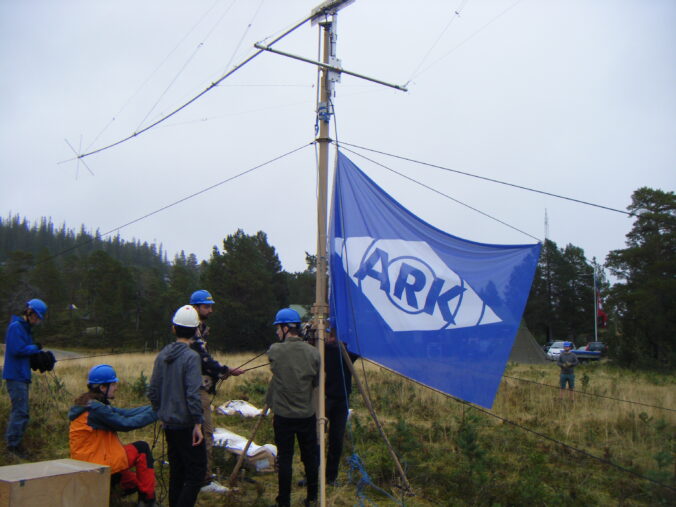
Once again, it was time for the biggest portable event of the year. As in previous years, we headed to Samatun utleiehytte in JP53HC for “National Field Day” for the first full weekend of September. This year, we gathered 50 old and new members for a weekend of contest and fun.

We arrived on Friday and spent the rest of the day eating burgers, socializing, planning the contest, and playing our own version of Jeopardy. On Saturday morning, we divided into teams we had made Friday evening and started setting up the antennas.

One of the teams put up our triband HD Spiderbeam wire yagi, an antenna that will be 10 years old next year. It has been a central part of our setup every year, not least for being our only antenna on the 20m band. It has proven very practical for our purpose, and was once again ready well in time for contest start.

One of the less established masts in our use is the “Comrod mast”. It was generously donated by Comrod by Jo Eide last year, and was then used to hold wire dipoles. This year, we unleashed its full potential by making a bracket to attach our old “Bannanaphone” 40m rotatable dipole. Now we could have it at 17 m height over ground, up from the 11 m height we used to have it at. We expected this extra height to lower the takeoff angle and help us reach further. We could not measure the improvement, but we logged 8 DX, which is more than we have had in the log in many years. This might partly be due to more FT8 this year than in previous years, but we also qualitatively assessed the antenna’s performance as good.

For the third year in a row, we put up our homemade 80m vertical with elevated radials. That went very quickly this year, and it was the first antenna that was QRV. We originally made it because we hoped the low take-off angle could help us to some DX QSOs on the lowest HF band, but we have still usually put up a low-hanging wire dipole to run NVIS. This year, we put up a low-hanging loop in place of the dipole. We also did a simple quantitative comparison of the vertical and the loop two.

Finally, we put up a wire dipole for 160m and a wire dipole for the 60m band. The 160m went up between two trees, which lifted it about 8-10m above the ground. Well short of the desired 80m elevation. We ended up placing the 60m dipole between the comrod mast and a 12m spiderbeam glassfiber mast. This was also a compromise on optimal height, but it was likely acceptable. The proximity to the 40m antenna turned out to be a larger issue. We struggled with devastating interference from 40m on the 60m receiver.

Reusing the same concept as last year, we invited the public to see what amateur radio can be like. We invited locals and cabin owners in the area through their Facebook page, in addition to anyone reading our Facebook page. We also sent emails to two of the local schools. Despite having our QTH at a quite remote location, we got quite a few visitors. Not so many children, but lots of interested adults instead.

We had our traditional foxhunt on Saturday evening. A total of 3 groups went out to hunt equally many beacons. The equipment worked well, but the daylight ended during the foxhunt, and the beacons proved difficult to find in the darkness. Still, the participants thought it was fun, and it was quite a different type of activity than the rest of the weekend.
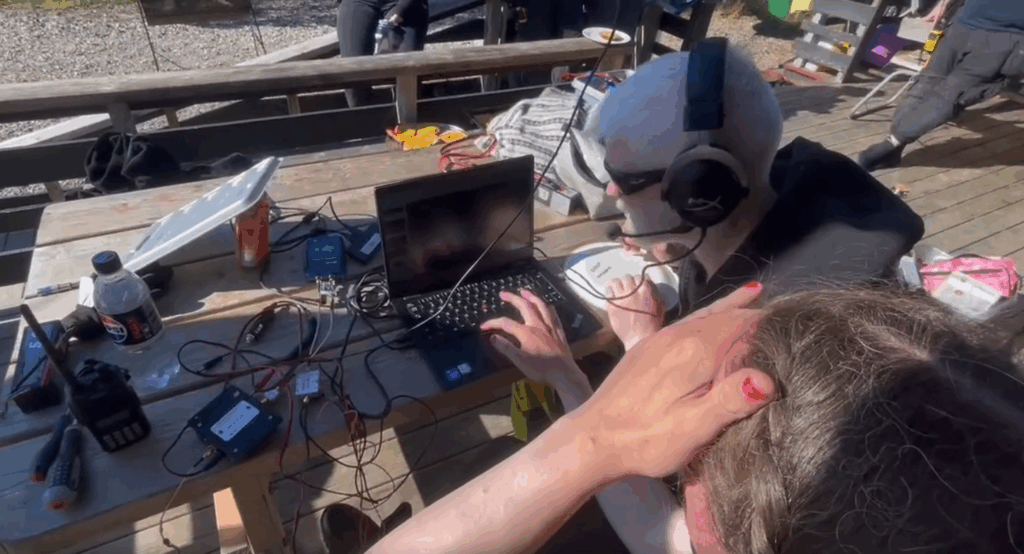
We found time to try two low-priority projects on Sunday morning: 6m and QO-100. Both were quite lacklusterly prepared, but we had the required equipment available.
We have done similar attempts at reaching QO-100 during earlier field days, but this time we had a slight change in setup. We used LA2QUAs Alalm Pluto SDR, ice cone TX antenna, and CN417 preamplifier with LA8ITAs wifi-amplifier, parabolic dish, and LNB. Everything was powered by a collection of batteries that we had lying around. All of this seemed to work well, so the main hurdle was tricking Windows into accepting input from an external microphone. Eventually, we solved it and got a single SSB QSO before the contest ended, our first QO-100 QSO as a portable station. The other station was the exotic LA4O/P, a mere 500 km away, but we believe the setup can be used to reach much further if we set it up earlier next year.

For our half-hearted 6m attempt, we brought a Yagi antenna that we put up on a large quadropod. That proved quick to assemble and point, but the band appeared completely dead. Not even FT8 could hear anything. This might have been due to issues with setting up the connection between IC-9100 and WSJT-X, but then again, 6m is not a stable band. It is not unlikely that there was nothing to be heard..

The results were good this year in many aspects. We had a relatively broad participation with 39 licensed and unlicensed operators in the log, an all-time high for an LA1K field day. Many of them also did a lot of contesting, and we were active both day and night. The QSO-count ended on 1444, our best result in more than 10 years, and our third-best field day result ever.

Many thanks to everyone who answered us, everyone who joined, and everyone who prepared this year’s Field Day!

Leave a Reply