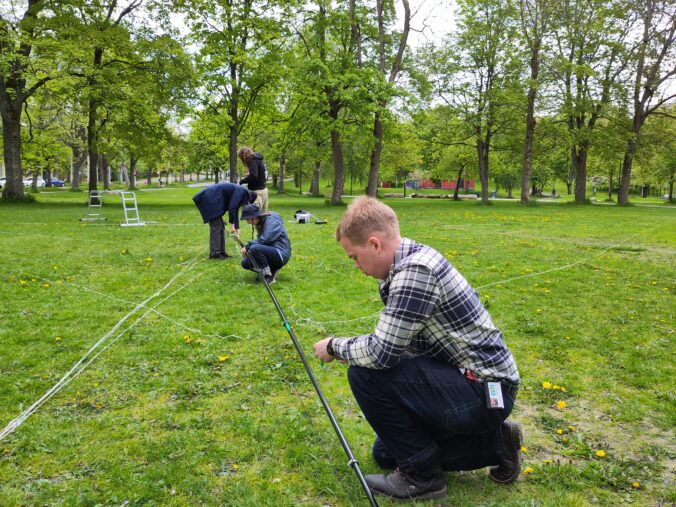
Over the past years, we have had a few different attempts at portable 80m wire verticals. The first one was a base-loaded vertical with a modest on-ground radial set on one of our 12m masts. A shortened vertical antenna like this one was expected to have some reduced performance, but it was relatively easy to make and deploy. Our next attempt was a full-size vertical with elevated radials. We intended it for Field Day and wanted extra performance. The antenna did not overwhelm us with QSOs, but it worked.

This time, on the 1st of June, we had two tricks we wanted to try out on the full-size vertical. First, we would try to do a more extensive retuning, and second, we wanted to add a common-mode choke.

As we usually do when we make this kind of antennas, we cut the wires a bit too long because it is easier to cut them than to lengthen them after measuring the resonance. We found that tuning for resonance by only adjusting the element led to a very short element compared to the radials, so we shortened the radials by an arbitrary amount compared to the initial cut. We had already tuned the antenna a few times now, learning something new each time. This time, we wanted to use what we had learned, tune both the element and the radials, and tune without hurry.

After some ups and downs with the mast, we found that more shortening of the radials did move the resonance of the antenna, but very, very little. It was much more sensitive to the length of the element than to the length of the radials. We ended up extending the radials back to the maximum length and tuned the element to fit within the band. Earlier, before we cut the radials, we had experienced more pronounced results of tuning the radial lengths, but perhaps they have a larger influence when they are longer than a wavelength. It could maybe also be that the common-mode choke made a difference. Now the length of the element and the radials were approximately the same, and we concluded that this was a reasonable tuning.

There is not much talk about baluns for vertical antennas, but common-mode currents from the antenna might still be a problem for verticals with elevated ground planes. We wound a choke based on the recipes from G3TXQ, which we attached at the feed point. The impact on the antenna pattern is difficult to assess, but it was immediately obvious that the bandwidth, measured by the range where the SWR is below 2, decreased. We interpreted this as a good thing and that the abnormally high bandwidth it used to have was due to common-mode currents on the coax.
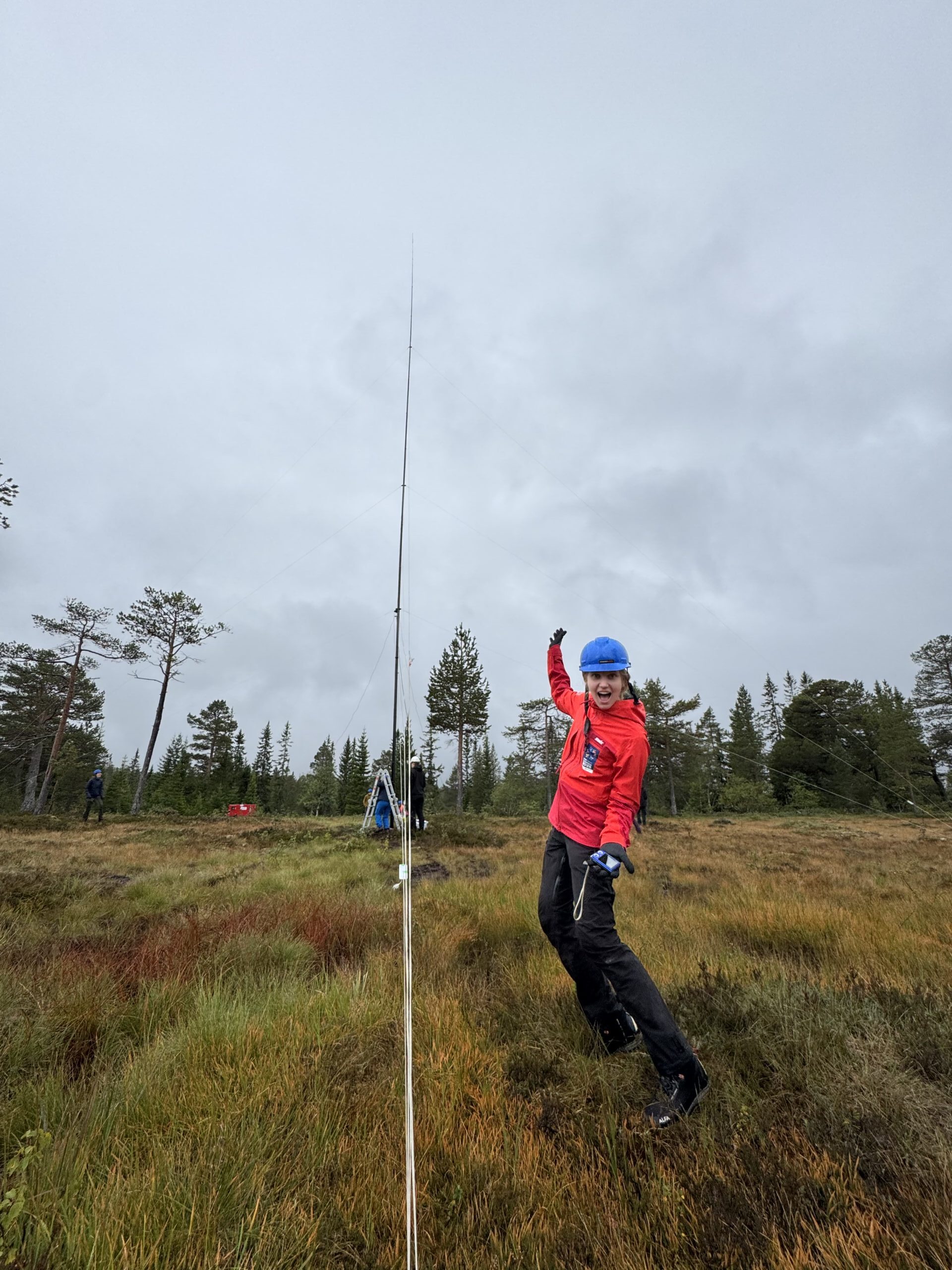
That was all for the preparation day, but we set it up again on Field Day as intended. The ground was slightly wetter and thus better than the park we used in June, but everything else was the same. We also put up an 80m loop that we used as a reference for comparison. At quarter past midnight UTC, we called CQ 3 times with CW with each antenna at minutely different frequencies and noted the results from the reverse beacon network. This was long after nightfall and would usually be a good time for the 80m band.
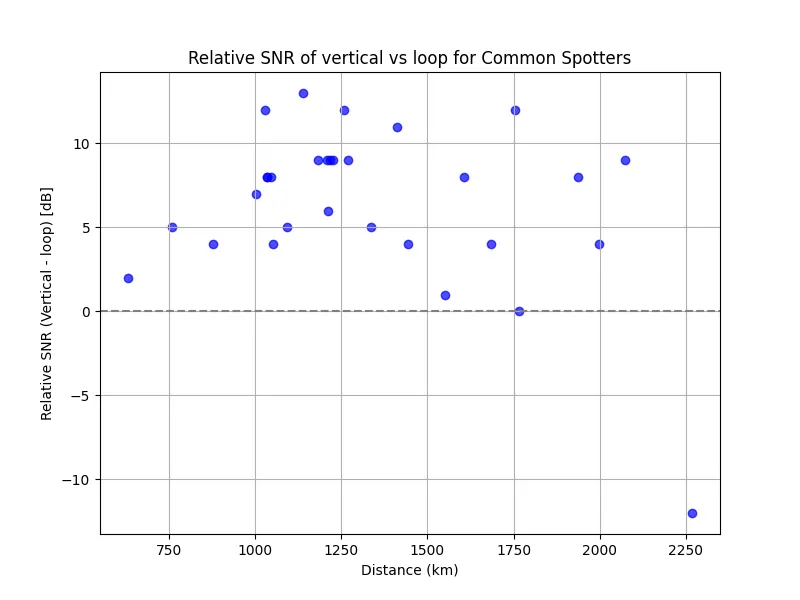
The results indicate that the vertical works the best, with 44 spots, while the loop only got 32 spots. In addition, most of the stations that spotted both reported better SNR for the vertical. This conclusion is however slightly weakened by the fact that the loop got spotted the furthest away, and had the best reported SNR on the furthest away common spot. Exactly why the loop seems inferior up to 2000 km distance and superior afterwards is quite difficult to say. Please let us know if you have an idea.

We also replaced the mount for the feedpoint of the antenna. Initially, we 3D printed a ring with the correct diameter to go around the mast so that the mount would hang firmly on the mast. The problem with this was that the needed diameter changed a lot when we tuned the length of the element, and a ring with the wrong diameter turned out to be very impractical. Fortunately, the modular design of the mount allowed us to replace the ring with a new 3D printed strap mount without redoing the rest.

Even if we did not do a major retuning of the antenna, we gained confidence in its tuning, and we made a few other improvements. In addition, it tested favourably compared to our loop antenna. Many thanks to everyone who put it up on Field Day, and in particular Bendik, Marianna, LB0CJ, LB3BK, and LB5DH, who helped prepare the antenna for Field Day.

Leave a Reply